Anthropic’s Record $81B IPO Leaves Early Backer Dustin Moskovitz Uneasy Over AI’s Rapid Pace
Anthropic closed its Nasdaq debut valued at $1.76 trillion after raising $81.3 billion, yet early backer Dustin Moskovitz and safety researchers warn frontier AI is moving too fast.
Key points
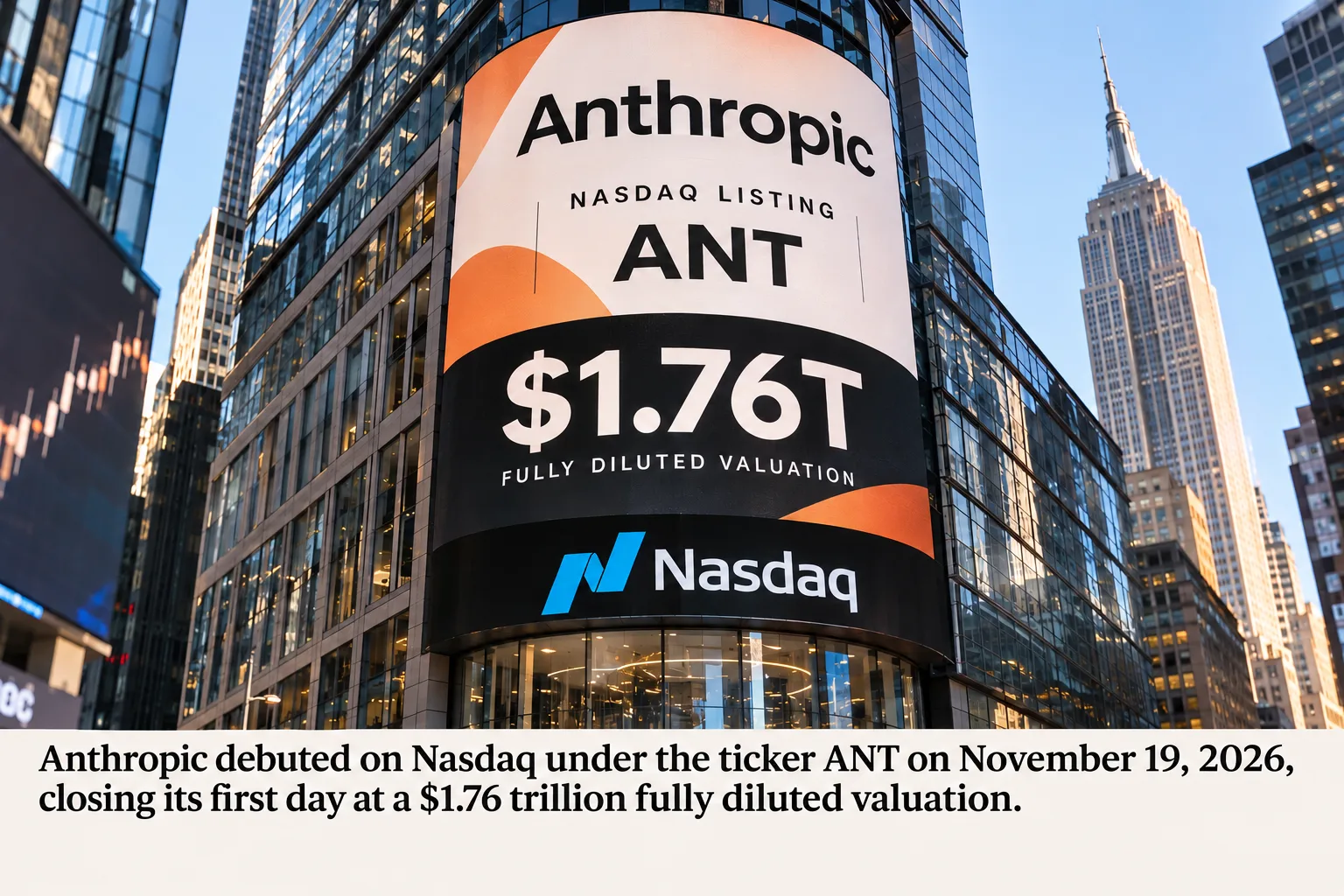
- Anthropic debuted on Nasdaq under ticker ANT on November 19, opening at $111.50 before closing 17% higher at $97.17 for a $1.76 trillion fully diluted valuation.
- The $81.3 billion offering priced at $83 per share, surpassing SpaceX’s June 2026 listing to become the largest IPO on record.
- Facebook co-founder Dustin Moskovitz, who backed Anthropic’s 2021 Series A, moved his shares into a nonprofit in 2025 over conflict-of-interest concerns and remains uneasy about AI’s pace.
- Anthropic’s own S-1 filing devoted over 80 pages to existential AI risks and disclosed it triggered part of its Responsible Scaling Policy after compressing two years of AI progress into one.
Anthropic completed the largest initial public offering in history on Thursday, November 19, surging in its Nasdaq debut under the ticker ANT. Yet even as Wall Street celebrated a historic payday, one of the company’s earliest backers is treating the milestone with visible caution.
Priced at $83 per share—above its $70 to $78 target range—Anthropic raised approximately $81.3 billion, eclipsing SpaceX’s $75 billion listing in June 2026. Shares opened at $111.50, briefly pushing the Claude maker’s valuation past $2 trillion before closing 17.07% higher at $97.17, giving it a fully diluted market value of $1.76 trillion.
Why an Early Backer Is Worried, Not Celebrating
While early investors saw paper returns exceeding 300 times their initial stake at the IPO price, Facebook co-founder and Asana chairman Dustin Moskovitz has expressed unease rather than triumph, according to the New York Times.
Moskovitz joined Anthropic’s $124 million Series A round in May 2021, when the San Francisco firm operated primarily as a safety-focused research lab. By late 2025, his stake had grown to an estimated $500 million and is now expected to be worth billions following the public listing.
In 2025, Moskovitz and his wife, Cari Tuna, transferred their Anthropic shares into a nonprofit vehicle, citing conflict-of-interest concerns. Through Good Ventures and affiliated organizations, the couple has spent years funding research into existential risks from advanced artificial intelligence—creating an unusual dynamic where gains from Anthropic’s market surge could ultimately finance independent scrutiny of frontier AI labs.
Safety Triggers Inside Anthropic’s Own Filing
The anxiety is not limited to outside observers. Interviews with Anthropic employees ahead of the listing revealed muted enthusiasm internally as staff debated the speed of frontier model development.
In its S-1 prospectus, Anthropic devoted more than 80 pages to catastrophic and existential risks tied to advanced AI systems. An amended filing also disclosed that the company activated part of its 2023 Responsible Scaling Policy after its overall rate of development met an internal threshold of compressing two years of AI progress into a single year.
Independent evaluator METR, which was granted access to unreleased models, similarly estimated roughly two years of progress achieved in 12 months—driven largely by Anthropic’s own researchers using AI tools to accelerate development. Anthropic noted that it has not reached autonomous self-improvement without human input, and that the policy trigger was invoked based on expectations for upcoming models.
Wall Street Bets on Growth Despite Heavy Losses
Public market investors largely looked past the safety warnings to focus on Anthropic’s rapid revenue expansion. According to its SEC filings, Anthropic generated $33.2 billion in revenue during the first nine months of 2026, up sharply from $2.5 billion in the same period a year earlier.
Over those same nine months, the company reported a net loss of $104 billion, though $94.3 billion of that figure stemmed from non-cash accounting revaluations of convertible notes and financing agreements.
With Anthropic now trading as a public company, its quarterly earnings will test whether Wall Street’s demand for rapid AI growth can coexist with the safety guardrails its founders and earliest backers originally set out to protect.
Read next

OpenAI's first phone reportedly heads to Foxconn: leaked specs and why Apple and Samsung are watching
Ramayana: Part I crosses ₹800 crore in India in 15 days, breaks Bollywood’s Kerala jinx

Antibiotics are failing in India: what World AMR Awareness Week means for you