OpenAI's first phone reportedly heads to Foxconn: leaked specs and why Apple and Samsung are watching
A Chinese supply-chain report says Foxconn's FIH Mobile has won orders to assemble OpenAI's first smartphone, tipped for late 2027 or 2028. Neither company has confirmed it.
Key points
- Securities Times reports Foxconn's FIH Mobile will help assemble OpenAI's first phone
- Neither OpenAI nor Foxconn has confirmed the order
- Launch tipped for late 2027 or 2028, according to Cailian Press
- Analyst Ming-Chi Kuo expects a custom MediaTek chip with two AI engines
- Apple is suing OpenAI over alleged trade-secret theft; OpenAI denies it
OpenAI's move from AI software into smartphones has reportedly reached a manufacturing milestone. According to a supply-chain report published on 19 November by the Chinese financial daily Securities Times, FIH Mobile, the Hong Kong-listed unit of iPhone assembler Foxconn, has won orders to assemble OpenAI's first phone.
Neither OpenAI nor Foxconn has confirmed the order. There is no official design, price or release date. A separate report from Cailian Press says the handset is aimed at a launch in late 2027 or 2028, which would put the ChatGPT maker in direct competition with Apple and Samsung.
A move into Apple's supply chain
The report marks a change from earlier expectations. In May, analyst Ming-Chi Kuo named Luxshare Precision as OpenAI's likely main manufacturing partner. The new reports say final assembly is going to Foxconn's FIH Mobile, while Luxshare stays involved as a component supplier alongside other Apple suppliers, including Lingyi iTech and AAC Technologies. One Chinese report describes FIH as taking part in assembly rather than being the only assembler, so the exact split is still unclear.


The hardware push follows OpenAI's roughly $6.5 billion deal last year for io Products, the device start-up co-founded by former Apple design chief Jony Ive.
The reported specs: built around two AI engines
Instead of a normal phone with a chatbot app, OpenAI is reportedly designing an "AI agent" phone that can complete multi-step tasks in the background, so people tap through fewer apps. Based on specifications outlined by Kuo and repeated across supply-chain coverage, the device puts on-device AI ahead of traditional benchmarks:
- Custom chip: a customised MediaTek Dimensity 9600, made on TSMC's advanced N2P process. Reports say OpenAI chose MediaTek over Qualcomm.
- Two NPUs: two neural processing units, one for heavy AI work and one low-power unit for always-on background tasks.
- Fast memory: LPDDR6 RAM and UFS 5.0 storage, to help run AI models on the phone itself.
- Camera as a sensor: an upgraded image processor with improved HDR, designed to help the AI understand what is around the user.
- Security: pKVM, a virtualisation technology for isolating sensitive processes, and inline hashing for checking data integrity.
- Volume: Kuo estimates about 30 million units across 2027 and 2028, if development stays on track.
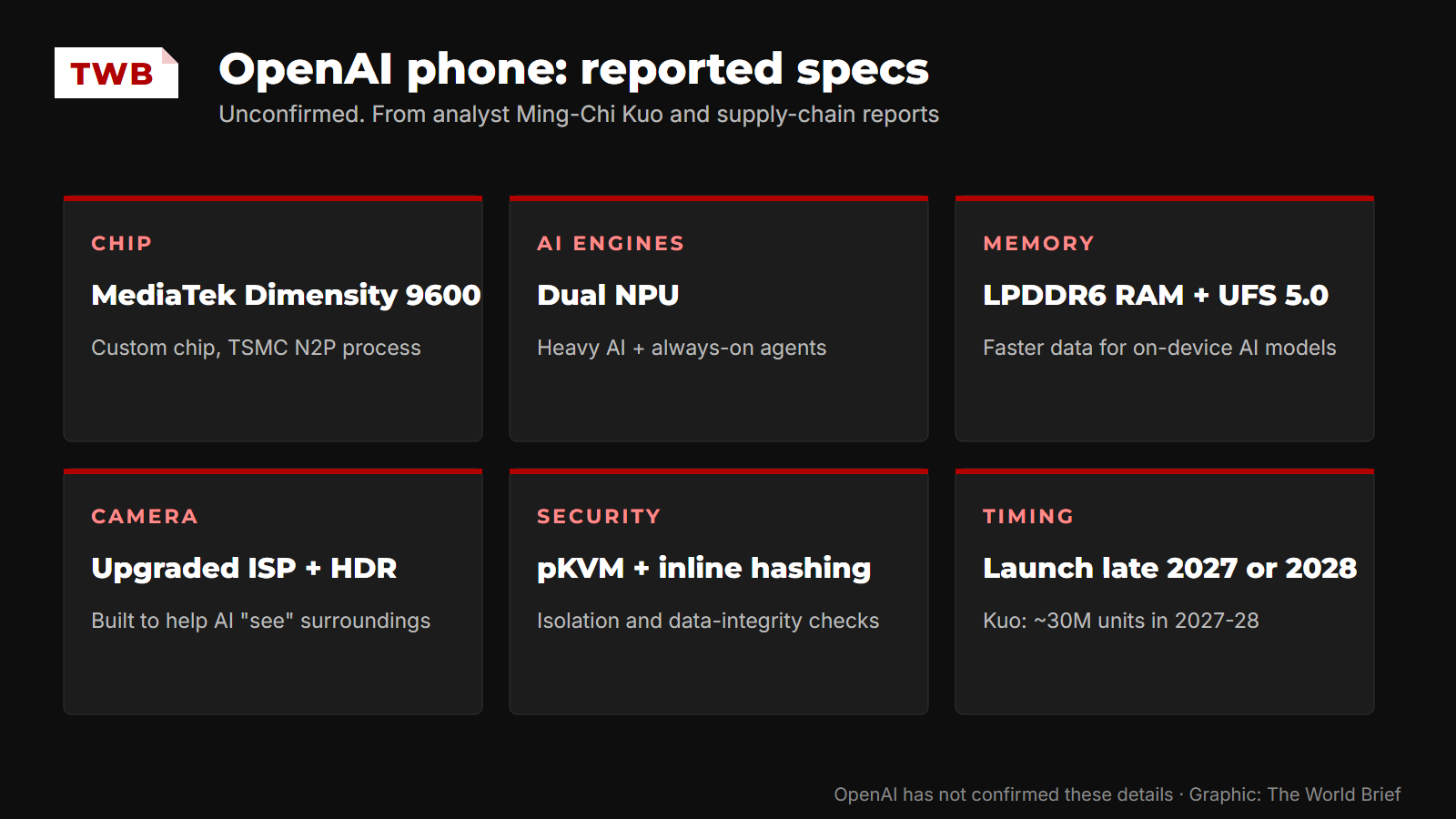
These details come from analysts and supply-chain sources. OpenAI has not commented on them.
Why Apple and Samsung are watching
For more than a decade, Apple and Google have controlled the main mobile platforms: the operating systems, the voice assistants and the default apps. A phone of its own would let OpenAI make ChatGPT the main way people use the device, rather than one app among many.


Phones also gather constant, real-time context about their users, which is the kind of information AI agents need to be genuinely useful.
The hurdles ahead
- Apple's lawsuit: on 10 July 2026, Apple sued OpenAI, its io Products unit and two former Apple employees in federal court in Northern California, alleging theft of hardware trade secrets. OpenAI has denied the claims and asked the court to dismiss the case. The dispute is still in court.
- The software question: it is not known whether OpenAI will build its own operating system or use a modified version of Android.
- Strong rivals: Google and Samsung are already building system-wide AI agents into Pixel and Galaxy phones. OpenAI will need to give buyers a reason to switch, rather than simply installing the ChatGPT app on the phone they already own.
What we know and what we don't
Reported: FIH Mobile's assembly role, Kuo's specifications and the late-2027 or 2028 timing. Not confirmed: the order itself, the design, the price, the operating system and the launch date. The World Brief will update this story when OpenAI or Foxconn comment.
Sources: Securities Times and Cailian Press via Android Authority and Gizmochina; Ming-Chi Kuo via GSMArena; Apple lawsuit via CNBC and NBC News; OpenAI's response via MacRumors.
Read next

Anthropic’s Record $81B IPO Leaves Early Backer Dustin Moskovitz Uneasy Over AI’s Rapid Pace

Ramayana: Part I crosses ₹800 crore in India in 15 days, breaks Bollywood’s Kerala jinx

Antibiotics are failing in India: what World AMR Awareness Week means for you