US proposes up to 25% tariff on Indian goods, 17% with a trade deal: why Washington is targeting Make in India and PLI
The US Trade Representative says India's industrial policies create 'structural excess capacity' and has proposed tariffs of up to 25% on Indian goods, cut to 17% if a trade deal is signed. India says it has no excess capacity in any sector and the notice is under examination.

Key points
- USTR has found India's practices on 'structural excess capacity' unreasonable under Section 301 of the US Trade Act of 1974
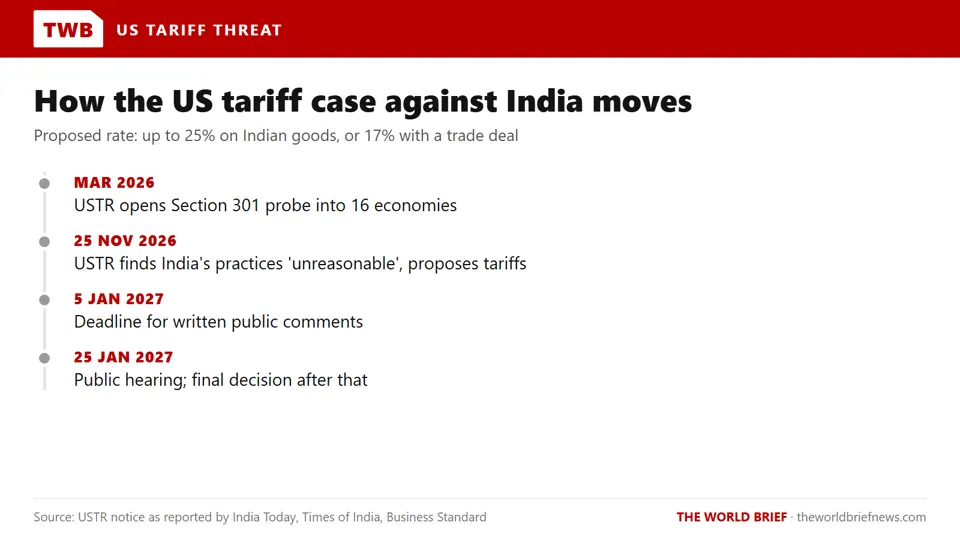
- It proposed tariffs of up to 25% on Indian goods, or 17% if India signs a qualifying trade agreement
- The 126-page report names Make in India, PLI, Atmanirbhar Bharat and IBEF, and flags steel, solar, pharma, medical devices and ICT
- India's commerce ministry says the notice is under examination and India has no structural excess capacity in any sector
- Written comments are due by 5 January 2027 and a public hearing is set for 25 January 2027, India Today reported
The United States has proposed tariffs of up to 25% on Indian goods, saying India's push to make more at home is creating factory capacity the world does not need. The rate could fall to 17% if India signs a trade agreement that addresses Washington's concerns.
The proposal comes from the Office of the US Trade Representative (USTR), which has ended an eight-month investigation under Section 301 of the US Trade Act of 1974. India's commerce ministry says the notice is "under examination" and that India "does not have structural excess capacity in any sector".
Quick facts
- What: proposed US tariffs of up to 25% on Indian goods, subject to exemptions and adjustments.
- Lower rate: 17% if India signs a qualifying reciprocal trade agreement with the US.
- Why: USTR says India's policies cause 'structural excess capacity and production' that hurts US commerce.
- Not just India: 14 economies got determinations, including China, the EU, Japan, South Korea, Vietnam and Bangladesh.
- Not final yet: written comments due 5 January 2027, public hearing on 25 January 2027 (India Today).
What the US is saying
USTR has concluded that India's "acts, policies and practices" on excess capacity are "unreasonable" and burden or restrict US commerce, according to India Today's reading of the 126-page report.
The idea is simple. If a country builds factories that can make 100 units when its own market needs only 60, and it does so because of government help rather than demand, the extra goods end up abroad. That means more exports, lower prices and tougher competition for American manufacturers. The US calls this "structural excess capacity".

Why Make in India and PLI are in the firing line
The report names four of India's best-known programmes, India Today reported:
- Make in India, for its manufacturing and export targets, including raising manufacturing to 25% of GDP. USTR says this would need roughly doubling current capacity.
- Production Linked Incentive (PLI) schemes, because they pay companies based on extra production or sales.
- Atmanirbhar Bharat (Self-Reliant India), for promoting home production and import substitution.
- India Brand Equity Foundation (IBEF), the commerce department trust that promotes Indian products abroad.
It also lists weak labour protections, "financial repression", barriers to foreign firms in India, and India's reliance on cheap inputs and investment from "non-market economies", mainly China. The sectors it flags are steel, solar, pharmaceuticals, medical devices and information and communications technology (ICT).
India's reply
In a statement on Wednesday, the commerce ministry said India had "engaged constructively throughout this investigation". It added that it had told USTR from the start that India has no structural excess capacity in any sector.
The ministry said trade concerns should be settled within the India-US Bilateral Trade Agreement (BTA) talks, and that the government "remains committed" to an early deal, the Times of India reported.
TWB analysis: a tariff that works as a bargaining chip
The gap between 25% and 17% is the real message. The US is telling New Delhi that the quickest way to avoid the higher rate is to close the trade deal on terms that answer these complaints. Since the case attacks the design of schemes like PLI, India may be asked to defend, or adjust, the very policies it uses to attract factories, at a time when the Union Cabinet is still approving new production incentives.

What it means for you
- Nothing changes today. The tariff is only proposed. Prices of goods in India are not directly affected.
- Exporters in steel, solar, pharma, medical devices and electronics should watch the 5 January comment deadline; industry bodies are likely to file objections.
- Jobs and markets: a final 25% duty would make Indian goods costlier in the US, which could hurt export-heavy companies and their workers.
- Trade deal: expect the India-US talks to speed up, because a deal is the route to the lower 17% rate.
What we don't know yet
It is not yet clear which products will be exempt, when any final tariff would take effect, or how the US will treat goods already covered by other duties. We will update this story as USTR publishes details.
More on The World Brief
- More business news
- US stock futures fall as Trump plans new tariffs
- Goyal: more countries want trade deals with India
Sources
- India Today (via MSN): Why US is attacking Make in India, Atmanirbhar Bharat in new tariff threat
- The Times of India (via MSN): Notice under examination: Government pushes back on fresh 25% tariff threat
- Business Standard: US proposes up to 25% tariff on India, offers 17% upon trade deal
- The Indian Express: US proposes 25% tariff on India, 17% after trade deal
- Hindustan Times: Make in India, PLI at heart of US case for proposed tariffs
- Office of the US Trade Representative (official website)