Fact check: Did 50 crore Indians come out of poverty under Modi? What the World Bank data actually says
PM Modi cited a World Bank report to say 50 crore people left poverty during BJP rule. The number matches the World Bank's estimate, but the report counts from 2011, three years before Modi took office, and uses a $4.20-a-day line. Verdict: partly true.
Key points
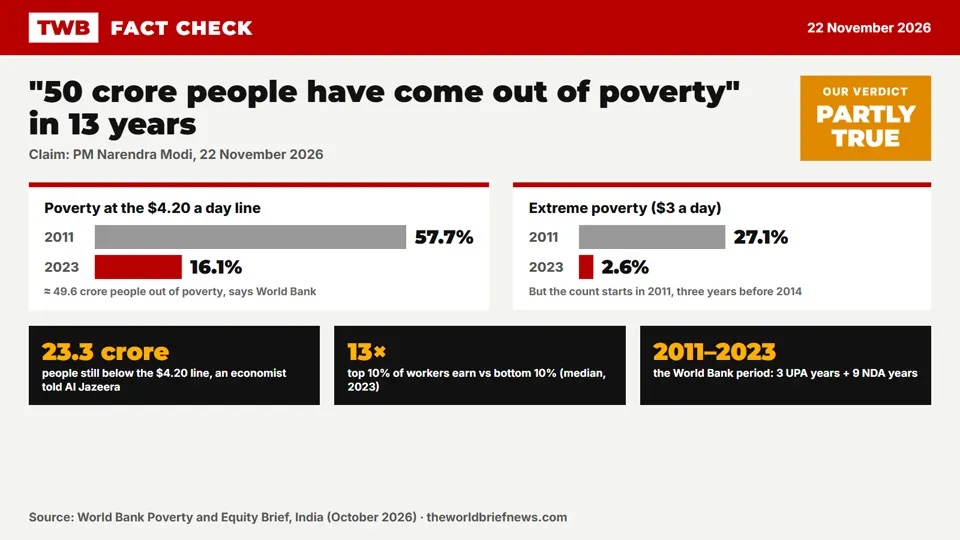
- The World Bank estimates about 496 million (49.6 crore) Indians moved above the $4.20-a-day line between 2011 and 2023
- Extreme poverty ($3 a day) fell from 27.1% in 2011 to 2.6% in 2023
- The period starts in 2011, under the UPA; Modi took office in May 2014
- About 23 crore people were still below the $4.20 line, an economist told Al Jazeera
- The World Bank also flags high inequality: the top 10% of workers earn 13 times the bottom 10%
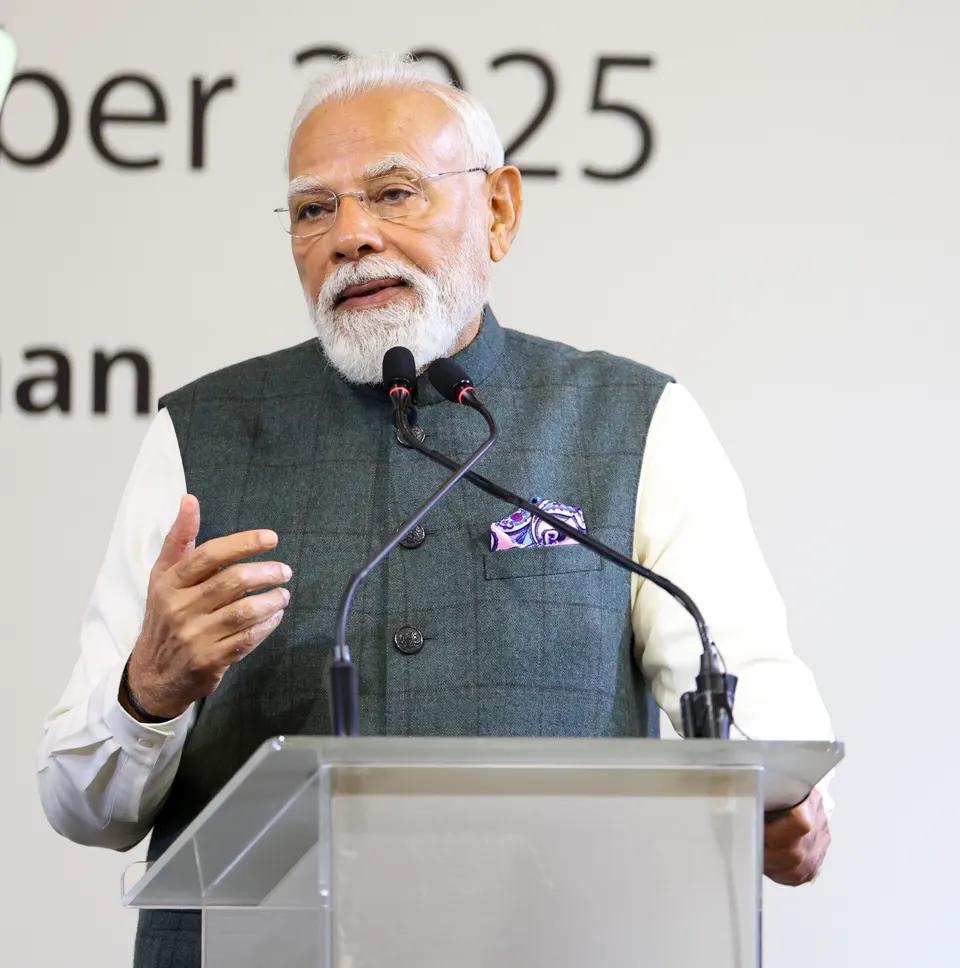
The claim: On 22 November, Prime Minister Narendra Modi told Gujarat BJP workers that "for the first time after 1,000 years of slavery, 50 crore people have come out of poverty", citing a World Bank report. He said "all of this happened during this period", meaning BJP rule.
Our verdict: Partly true. The 50 crore figure matches the World Bank's estimate. But the World Bank's count runs from 2011, three years before Modi became prime minister, and it uses a specific poverty line.
The numbers at a glance
- 49.6 crore people moved above the $4.20-a-day poverty line between 2011 and 2023 (World Bank).
- $4.20 line: 57.7% of Indians below it in 2011, 16.1% in 2023.
- Extreme poverty ($3 a day): 27.1% in 2011, 2.6% in 2023.
- Period: 2011–2023. The UPA governed until May 2014; the NDA since.
What the World Bank actually found
The World Bank's October 2026 poverty brief on India, based on government household consumption surveys, found one of the fastest falls in poverty in the world:
- Extreme poverty, measured at $3 a day (2021 prices), fell from 27.1% to 2.6% between 2011 and 2023.
- At the higher $4.20-a-day line for lower-middle-income countries, the share fell from 57.7% to 16.1%. That is about 496 million (49.6 crore) people.
- The Bank credits strong consumption growth, more jobs, especially for women, and bigger welfare transfers, including free food grains.
Where the claim needs context
- The timeline: the World Bank period starts in 2011. Roughly three of those twelve years were under the Congress-led UPA. Poverty in India has been falling since the economy opened up in the early 1990s. So the full 50 crore cannot be credited to one government, though most of the period was under the NDA.
- "13 years": the report covers 2011–2023, which is 12 years. It is not 2014–2026.
- The poverty line matters: the 50 crore figure uses the $4.20 line. At the extreme-poverty line, the World Bank counted about 7.5 crore people still poor in 2023.
- Better measurement: the World Bank said part of the measured gain in recent years likely reflects improved survey methods, not only real change.
What critics and economists say
- Former IMF executive director Surjit Bhalla told Al Jazeera that World Bank data is the "gold standard" and is vetted by India before release.
- Economist Santosh Mehrotra asked why India no longer sets its own poverty line.
- Economist Jayati Ghosh pointed to stagnant real wages. The report itself found the top 10% of workers earned about 13 times the bottom 10%.
- Lecturer Nitin Kumar Bharti said about 233 million people still live below the $4.20 line.
Our verdict
Partly true. India has achieved a very large, World Bank-confirmed fall in poverty, and the 50 crore number is accurate for 2011–2023 at the $4.20 line. But presenting it as entirely the result of BJP rule leaves out that the counting period began in 2011, under a different government.