Government health spending triples to ₹4.14 lakh crore; families' out-of-pocket share falls to 42.7%
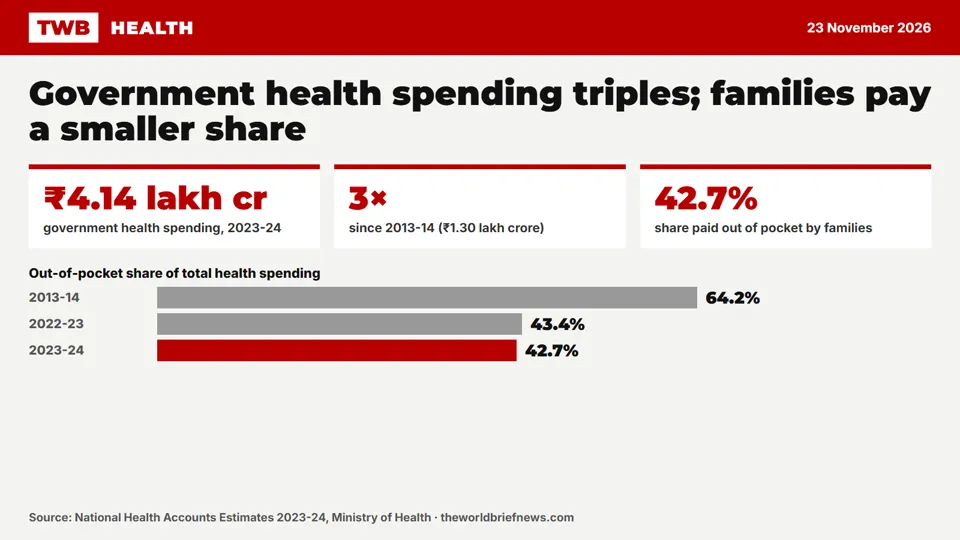
New National Health Accounts estimates show government health spending rose from ₹1.30 lakh crore in 2013-14 to ₹4.14 lakh crore in 2023-24, while the share of health costs paid directly by families fell from 64.2% to 42.7%.
Key points
- Government health spending rose from about ₹1.30 lakh crore (2013-14) to ₹4.14 lakh crore (2023-24)
- Out-of-pocket spending fell from 64.2% to 42.7% of total health spending
- In the latest year it fell from 43.4% (2022-23) to 42.7% (2023-24)
- These are the 11th round of National Health Accounts estimates, by the Health Ministry's NHA Technical Secretariat
- Families still pay over two-fifths of all health costs themselves
India's government is spending far more on health, and families are paying a smaller share of medical bills from their own pockets. That is the headline from the latest National Health Accounts (NHA) estimates for 2023-24.
Key findings
- Government health spending: ₹4.14 lakh crore in 2023-24, up from about ₹1.30 lakh crore in 2013-14, more than three times.
- Out-of-pocket share: down from 64.2% to 42.7% of total health spending.
- Latest year: 43.4% in 2022-23 to 42.7% in 2023-24.
- Who prepared it: the Health Ministry's NHA Technical Secretariat, 11th round.
What is "out-of-pocket" spending?
It is money people pay directly for doctors, medicines, tests and hospital stays, not covered by government schemes or insurance. High out-of-pocket costs can push families into debt or poverty, which is why health experts track this number closely.
Why spending rose
- Expansion of Ayushman Bharat PM-JAY, which offers free hospital care up to ₹5 lakh a year to eligible families.
- More health and wellness centres, free medicines and diagnostics in public facilities.
- Pandemic-era investment in hospitals and health systems.
The work still to do
Even at 42.7%, Indian families still pay over two-fifths of all health costs themselves, higher than in many countries. Medicines and outpatient visits, often not covered by insurance, make up a large part of these costs.