Supreme Court orders separate 'HIGH SUGAR', 'HIGH SALT', 'HIGH FAT' warnings on packaged food: what changes for you
The Supreme Court has told food regulator FSSAI to put a separate red hexagon warning on the front of packaged foods for each of sugar, salt and saturated fat when they cross set limits, rejecting a single combined warning. FSSAI has about four months to finish the rules.
Key points
- A bench of Justices J.B. Pardiwala and K. Vinod Chandran ruled on 26 November 2026
- Each nutrient that crosses the limit gets its own red hexagon: 'HIGH SUGAR', 'HIGH SALT' or 'HIGH FAT', on the front of the pack
- Each hexagon must cover at least 4-5% of the main display panel, ANI reported
- FSSAI must use total sugars and saturated fat (not just added sugar and fat) and fix new science-based limits
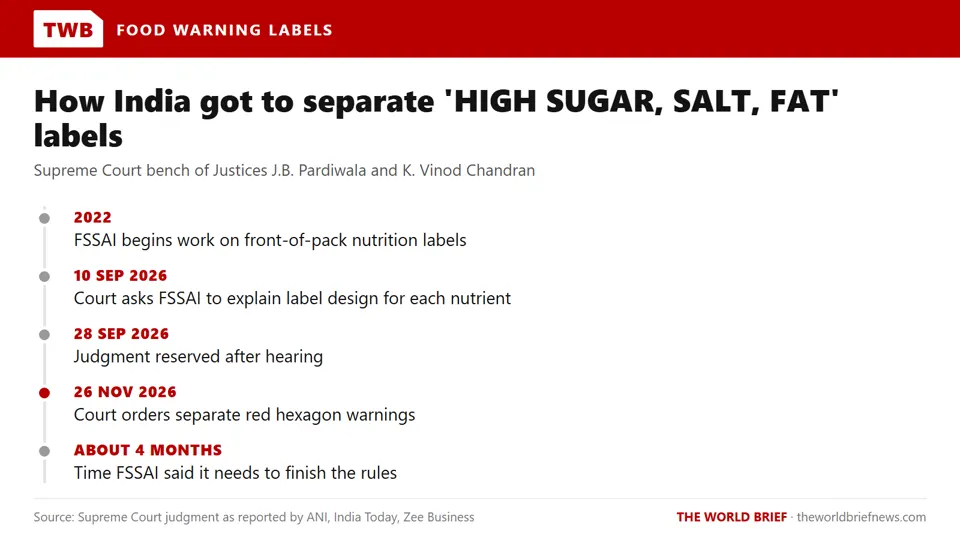
- The court accepted FSSAI's request for about four months to complete the rules, in a single phase
Packets of chips, biscuits, cold drinks and other packaged foods in India will soon have to carry a clear red warning on the front for each unhealthy nutrient they contain too much of, the Supreme Court ruled on Thursday.
A bench of Justices J.B. Pardiwala and K. Vinod Chandran told the Food Safety and Standards Authority of India (FSSAI) to use separate red hexagons reading "HIGH SUGAR", "HIGH SALT" and "HIGH FAT". The regulator had proposed one combined warning, which the court said did not tell shoppers enough.
Quick facts
- Ruling: 26 November 2026, on a petition by the non-profit 3S and Our Health Society.
- What: one red hexagon for each nutrient that crosses the limit, on the front of the pack, with a picture symbol.
- Size: each hexagon must cover at least 4-5% of the front panel, ANI reported; text at least one point bigger than the nutrition table, India Today reported.
- Which nutrients: total sugars, saturated fat and salt.
- When: FSSAI asked for about four months to finish the rules; the court called that reasonable.
What the court ordered
Under the order, a warning is needed if even one nutrient crosses the limit. FSSAI's earlier plan would have started by covering only products with two or more nutrients in excess, India Today reported.
The court also told FSSAI to measure total sugars and saturated fat, not only "added" sugar and fat, and to set fresh limits based on scientific evidence. It warned against getting the numbers wrong in either direction. Limits set too low would put a warning on almost every product and cause "label fatigue", while limits set too high would let most products escape, the bench said, according to ANI.

Why the court stepped in
Work on front-of-pack labels has been going on since 2022. The judges questioned the delay and objected to FSSAI's idea of giving companies 365 days of voluntary compliance, saying public health cannot come second to business interests, India Today reported. The court linked the issue to the right to life and health under Article 21 of the Constitution, pointing to children's exposure to sugary drinks and snacks.
Who is on the bench

Justice Pardiwala and Justice K. Vinod Chandran heard the case and reserved their verdict on 28 September after asking FSSAI on 10 September to explain how each nutrient would be shown on the label.
TWB analysis: the real fight is now over the numbers
The design question is settled; the limits are not. Because the court has asked for limits based on total sugar and saturated fat, many products, including some that are sold as "healthy", could end up with a red hexagon. India's packaged food industry, valued at about $100 billion according to India Today, has resisted strict warnings. Expect heavy lobbying over the exact cut-offs during the next four months.
What it means for you
- Nothing changes on shelves today. Labels will change only after FSSAI notifies the new rules.
- Easier choices: parents and people with diabetes, high blood pressure or heart disease will see at a glance what a product is high in.
- Until then: turn the pack over and check sugar, salt (sodium) and saturated fat per 100 g in the nutrition table.
- Possible recipe changes: companies may cut sugar or salt to avoid a red label, as has happened in countries such as Chile and Mexico that use warning labels.
What we don't know yet
FSSAI has not yet published the new limits or the exact date the labels become compulsory. It is also not clear how long companies will get to use up old packaging. We will update this story when FSSAI issues the rules.
More on The World Brief
- More health news
- FSSAI tests packaged drinking water across India
- Kerala teen's kidney disease linked to mercury cream
Sources
- ANI via Asianet Newsable (MSN): Supreme Court mandates nutritional warning labels on packages
- India Today (via MSN): Supreme Court orders separate front-of-pack warnings for high sugar, salt and fat foods
- Zee Business (via MSN): Supreme Court orders separate warning labels for junk food high in sugar, salt, and fat
- Firstpost: Add 'high sugar, salt, fat' warning labels on packaged foods, Supreme Court directs FSSAI
- Financial Express: What Supreme Court has directed FSSAI to do
- FSSAI (official website)