Is Delhi's official AQI hiding its worst days? What a new analysis found, and how to read the number
A Hindustan Times analysis says the way CPCB calculates the Air Quality Index makes Delhi's most polluted days look better than they were, with 10 'severe' days reported in a year against 23 by the index's own definition. CPCB says its method reflects 24-hour exposure. Here is what it means for your health.
Key points
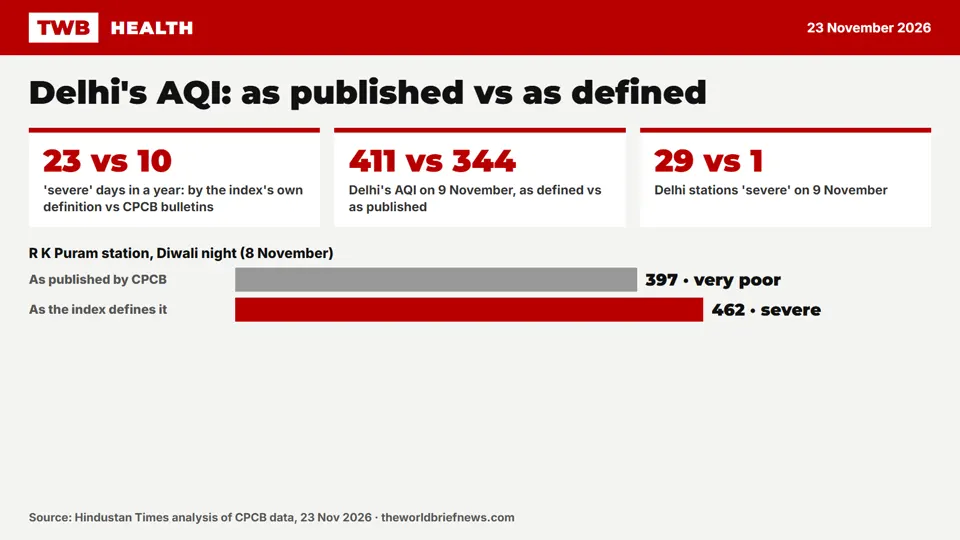
- A Hindustan Times analysis says CPCB averages hourly AQI scores instead of averaging pollution first, as the index's definition says
- By the definition, Delhi had 23 'severe' days in a year; CPCB's daily bulletins reported 10
- On 9 November, the day after Diwali, Delhi's AQI would have been 411 ('severe') instead of the published 344
- CPCB has said readings above 1,000 µg/m³ are left out because older analysers are calibrated only up to that level
- CPCB says its index reflects exposure over the past 24 hours and denies under-reporting; it did not answer HT's questions
India's official Air Quality Index (AQI) may be making Delhi's worst pollution days look better than they really were. That is the finding of an analysis by the Hindustan Times, published on 23 November, which recalculated a year of hourly readings from Delhi's government monitoring stations.
Key findings, according to HT
- 23 vs 10: Delhi would have had 23 'severe' days in a year by the index's own definition. CPCB's daily 4 pm bulletins reported 10.
- 9 November: the day after Diwali, the city's AQI would have been 411 ('severe'), not the published 344 ('very poor').
- Stations: 29 Delhi stations would have been 'severe' that day; CPCB rated one.
- Cleaner days: the same method makes them look slightly worse, by less than 10 points.
- Response: CPCB did not reply to HT's questions.
Where the difference comes from
The AQI is meant to sum up the pollution you breathe over a day. CPCB documents say each pollutant should first be averaged over 24 hours, and that one average is then turned into a score. HT found that CPCB's published figures instead convert each hour into a score first, then average the 24 scores.
The order matters because the AQI scale flattens at the top. An hour twice as smoky as a 'very poor' hour scores only about a third higher. So when a few night hours are extremely polluted, scoring them one by one shrinks their effect before they reach the daily average.
The worst hours are capped, or dropped
- Each hour's score stops at 500, the top of the scale. HT says a PM2.5 reading reaches that at about 420 µg/m³, so an hour at 2,000 counts the same as one at 420.
- In a statement on 10 November, CPCB said readings above 1,000 µg/m³ are not used, because its analysers are calibrated only up to that level. During extreme episodes such as Diwali, this can show up as a data gap.
- On 9 November, 12 stations were left out of Delhi's city figure for lack of enough hourly data; seven of them had readings above 1,000 blanked, according to HT.
What CPCB says
CPCB has said that differences between its numbers and private apps come from method, not under-reporting. Its index, it says, reflects exposure over the previous 24 hours, which is the right basis for health advice, while private apps can show higher values during short peaks. Ashoka University professor Gautam Menon told HT that if the method changed at an unknown date, "comparisons across that date are unsafe".
How to read the AQI
- 0–50 good · 51–100 satisfactory · 101–200 moderate · 201–300 poor · 301–400 very poor · 401–500 severe.
- A score of 100 matches India's legal daily limit for PM2.5, 60 µg/m³. The WHO's guideline is much stricter, at 15 µg/m³.
- On Sunday, 22 November, Delhi's AQI was 237 ('poor') at 9 am, with 36 of 54 stations in the 'poor' range and five 'very poor', PTI reported.
What it means for you
- On days rated 'very poor', especially in November, treat the air as possibly 'severe', particularly if you have asthma, heart disease or are elderly.
- Look at hourly PM2.5 readings for your nearest station, not just the daily AQI, before exercising or sending children outdoors.
- Wear a well-fitted N95 mask outdoors on bad days, and keep windows closed during the night-time peak.
- Read: pollution-linked health insurance claims have risen 4.3 times.
More on The World Brief
- More health news
- Pollution-linked insurance claims rise 4.3 times
- COP31 ends without a deal on fossil fuels