Maharashtra water crisis: 19 Marathwada dams run dry as 1,323 tankers supply 1,102 villages
Nineteen dams in Marathwada have dried up and tanker demand has doubled in a month. Maharashtra's dam storage is down to 61.88% from 90.26% a year ago, and drought has been declared in 310 talukas.
Key points
- 19 dams in Marathwada have run completely dry, with tanker demand doubling in a month.
- 1,323 tankers are supplying 1,102 villages and 3,801 hamlets in 11 districts; Beed alone has 326.
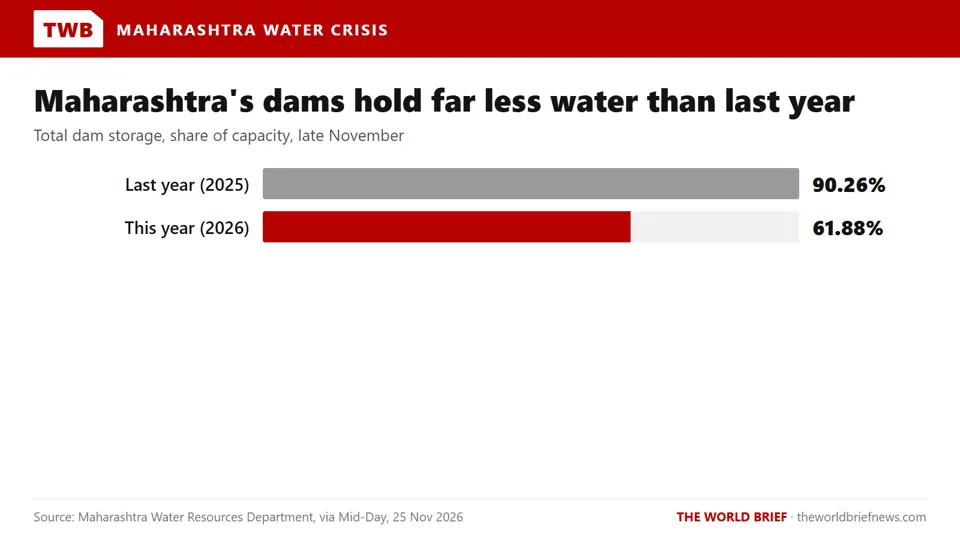
- Maharashtra's dam storage is 61.88%, down from 90.26% a year ago.
- Drought is declared in 310 talukas; 13 more are being surveyed.
- Officials warn tanker demand will keep rising as local schemes fail.
Maharashtra is facing a fast-worsening water crisis, with 19 dams in the Marathwada region now completely dry and demand for water tankers roughly doubling over the past month, Mid-Day and IANS reported on 25 November, citing the state government's latest figures.
The numbers
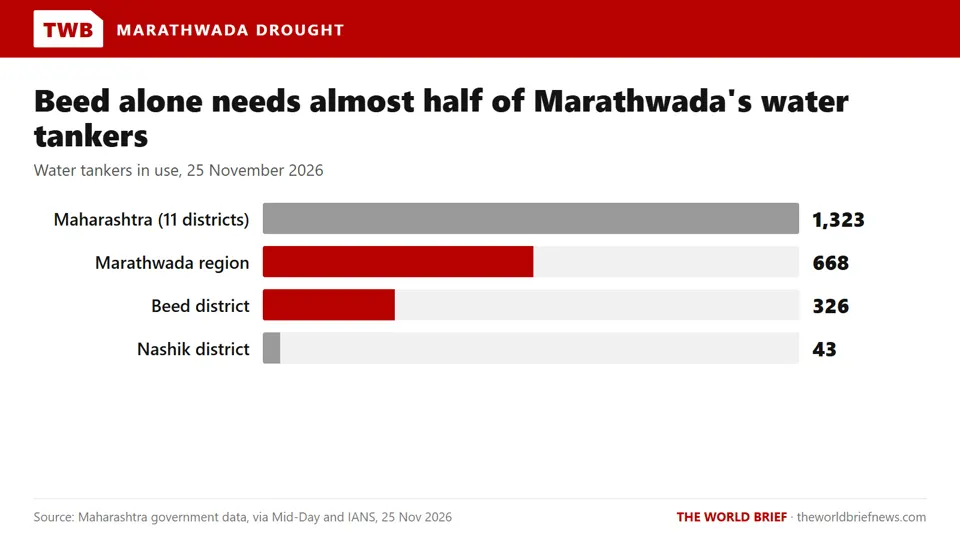
- Tankers: 1,323 tankers are supplying drinking water to 1,102 villages and 3,801 hamlets across 11 districts.
- Marathwada worst hit: 668 of those tankers are in Marathwada; Beed district alone has 326.
- Nashik: 43 tankers deployed despite the district having many dams.
- Drought: declared in 310 talukas; 13 more are being surveyed.
- Dam storage: 61.88% of capacity across Maharashtra, compared with 90.26% at the same time last year, according to the Water Resources Department.
- By region: Konkan is at 79% and Pune division at 72.44%, while Marathwada is far lower.
TWB analysis: how bad is it?
Our calculation from the state's own figures shows how sharp the fall is:
- Storage is down 28.4 percentage points from last year (90.26% to 61.88%), meaning dams across the state hold about 31% less water than they did at this time in 2025.
- Half of Marathwada's tankers are in one district: Beed's 326 tankers are 49% of the region's 668.
- Marathwada uses half of all tankers in the state (668 of 1,323) even though it is one of six revenue divisions.
- With storage already this low in November, the gap between supply and demand is likely to widen through the dry months until the monsoon, so tanker numbers are likely to keep rising.
Why this is alarming in November
Water shortages usually peak in April and May. Having dams run dry and tanker demand double this early in the season means the coming summer could be much harder, officials warned. The state's Water Supply Department expects tanker demand to keep rising as village water schemes fail.
Who is hit hardest
Farmers and rural families in Beed, and the rest of Marathwada (Chhatrapati Sambhajinagar, Jalna, Latur, Dharashiv, Nanded, Parbhani and Hingoli), depend heavily on these reservoirs for drinking water and irrigation. Women and children often walk long distances to fetch water when tankers are delayed.
What families can do
- Report shortages to the gram panchayat or tehsildar so your village gets tanker supply.
- Store water safely in covered containers and boil or filter tanker water before drinking.
- Check if your taluka is on the drought list: drought-declared talukas get relief such as loan rescheduling and fee waivers under state rules.
What happens next
The state is surveying 13 more talukas for drought status. Watch for new relief measures, tanker numbers and the state's water-rationing plans for cities as storage falls further.
With inputs from Mid-Day and IANS.