Chariot-1: India launches home-built AI model for 10 Indian languages under IndiaAI Mission
MeitY Secretary S Krishnan launched Chariot-1, an AI language and speech model trained from scratch in India, and said the government's AI regulation papers are in their final stages.

Key points
- Chariot-1, built by Chariot Artificial Intelligence Pvt Ltd under the IndiaAI Mission, was launched at Bharat Mandapam, New Delhi
- It works in English and 10 Indian languages and combines text, text-to-speech and speech recognition in one model
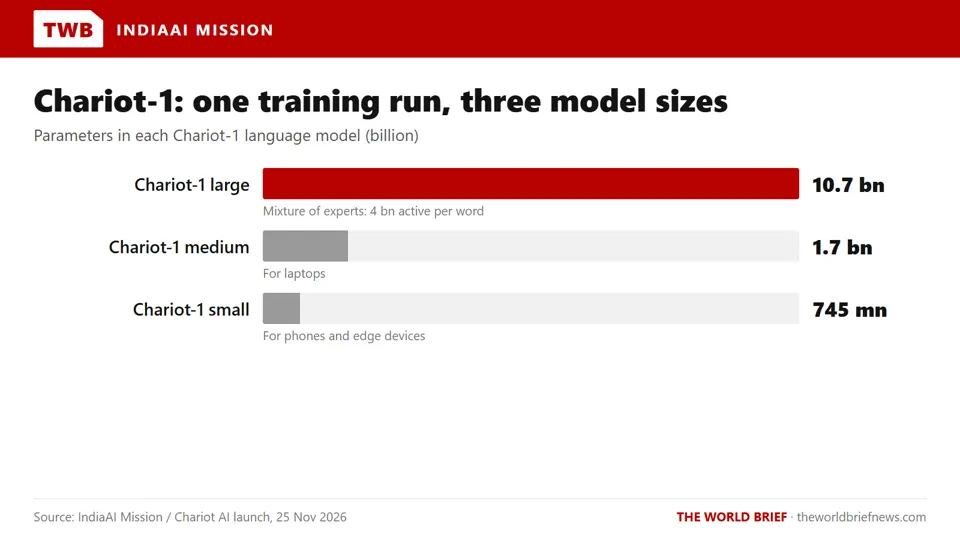
- The main model has about 11 billion parameters, with 4 billion active per word, and comes in three sizes down to 745 million for phones
- Its 'IndicShift' shared alphabet processes Indian text with up to 2.5 times fewer tokens than OpenAI's GPT tokeniser, the team says
- MeitY Secretary S Krishnan said government AI regulation papers are 'in the final stages' and will come out shortly
India has launched Chariot-1, an artificial intelligence (AI) model built and trained from scratch in the country under the government's IndiaAI Mission. It understands and speaks English and 10 Indian languages.
Ministry of Electronics and Information Technology (MeitY) Secretary S Krishnan unveiled the models at Bharat Mandapam in New Delhi on Wednesday, 25 November 2026. He also said the government's long-awaited AI regulation papers are almost ready. "It's in the final stages. We'll bring it out shortly," he said, ANI reported.
Chariot-1 at a glance
- Who built it: Chariot Artificial Intelligence Pvt Ltd, one of the first four teams chosen under the IndiaAI Mission to build sovereign foundation models.
- What it does: text generation, text-to-speech (TTS) and speech recognition, in one model.
- Languages: English plus 10 Indian languages.
- Size: an 11-billion-parameter "mixture of experts" model with 4 billion parameters active per word, in three sizes.
- Built in India: pre-trained from scratch, using GPUs made available through the IndiaAI Mission.
What makes Chariot-1 different
Most AI models need separate systems for writing text, reading it aloud and understanding speech. Chariot-1 does all three with one "backbone", co-founder Parth Sarthi said. "We don't need, like, 20 models, whereas one model is enough to do 20 things," he said.
The team presented three research ideas, according to the launch material:
- IndicShift: a shared alphabet for Indian scripts. It maps 1,012 characters across 12 scripts onto 350 letters, so the model can learn from similarities between languages. The team says this cuts the number of tokens (word pieces) for Indian text by up to 2.5 times compared with OpenAI's GPT tokeniser, and lifts performance on Indian languages by 5% to 8%. IndicShift is open source.
- Nested Training: trains three model sizes in a single run, which the team says is 62% faster than training them separately.
- Mixture of Vocabularies: splits the vocabulary into 11 groups and scores only the relevant one, making training 38% faster on the same GPUs.
These are the developers' own figures. They have not yet been tested by independent researchers.
Why it matters
The Constitution lists 22 languages in its Eighth Schedule, but most leading AI models are trained mainly on English. Tokenisers built for English break Indian words into many small pieces, which makes AI slower and costlier in Hindi, Tamil or Bengali. A model that handles Indian scripts efficiently could lower the cost of AI services such as voice assistants, customer helplines and government apps in local languages.
Krishnan said the launch "vindicated" the IndiaAI Mission's faith in young Indian talent. He noted that the founders had studied at Stanford and worked at leading AI labs before returning to India.
TWB analysis: what 2.5 times fewer tokens means
AI services are usually priced per token. If a Hindi sentence needs 2.5 times fewer tokens, the same budget could process about 2.5 times more Indian-language text, or the same text at about 60% lower cost (1 − 1 ÷ 2.5, our calculation), assuming the price per token stays the same. That is the economic case for "sovereign" models built around Indian languages.
What we don't know yet
- Which 10 Indian languages are covered in full, and how the model compares with global models on independent tests.
- Whether, and on what terms, businesses and the public can use Chariot-1.
- When the government's AI regulation papers will be published, and what they will propose.
What happens next
Chariot is one of several teams building foundation models under the IndiaAI Mission. More launches are expected, alongside the AI governance papers that Krishnan said are coming "shortly".
With inputs from ANI and the IndiaAI Mission launch material.