RBI eases cash rule for banks from 1 December: daily CRR minimum cut back to 90% as liquidity turns tight
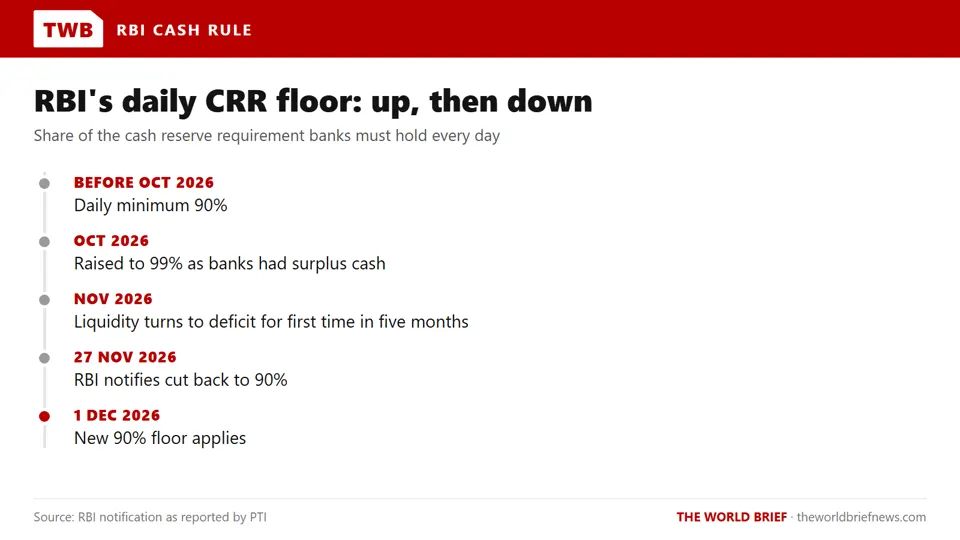
The Reserve Bank of India has cut the share of the cash reserve ratio that banks must keep with it every day from 99% back to 90%, from the fortnight starting 1 December 2026. The move gives banks more room to manage cash after system liquidity slipped into deficit.

Key points
- RBI cut the minimum daily CRR maintenance from 99% to 90% of the requirement
- The change applies from the fortnight beginning 1 December 2026
- RBI had raised it to 99% from 90% in October, when banks had surplus cash, PTI reported
- The CRR itself is unchanged at 3% of deposits
- Banking system liquidity recently turned to deficit for the first time in five months, PTI reported
The Reserve Bank of India has eased a cash rule for banks just as money in the banking system has become tight. From 1 December 2026, banks will need to keep at least 90% of their required cash reserve with the RBI on any given day, down from 99%.
"On the basis of an assessment of the current and evolving macroeconomic situation and liquidity conditions, it has been decided" to make the change, the central bank said in a notification on Friday, according to PTI.
Quick facts
- What changed: minimum daily CRR maintenance cut from 99% to 90% of the requirement.
- From: the fortnight beginning 1 December 2026.
- Not changed: the cash reserve ratio itself stays at 3% of deposits.
- Background: RBI raised the daily minimum to 99% in October, when banks had surplus cash.
- Why now: system liquidity turned to deficit for the first time in five months, PTI reported.
What is the CRR, and what is the daily minimum?
The cash reserve ratio (CRR) is the part of their deposits that banks must park with the RBI. They earn no interest on it. Today it is 3% of deposits.
Banks do not have to hold the full amount every single day. They must meet it as an average over a fortnight, but on each day they must hold at least a set share of it. That daily floor is what the RBI has changed. At 99%, banks had almost no room to dip below the requirement on busy days. At 90%, they can use more of that cash on days when they are short, and make it up later in the fortnight.
Why the RBI reversed course
In October, banks had more cash than they needed, so the RBI raised the daily floor to 99% to soak up some of it. Since then the situation has flipped. Liquidity turned to a deficit for the first time in five months, because of tax (GST) payments flowing out of banks and the RBI's own dollar sales in the currency market to support the rupee, PTI reported.
BW Businessworld estimated that the change could free about ₹50,000 crore for banks. The RBI has not given a figure.
TWB analysis: a quiet signal
This is a technical step, not a cut in the CRR or the repo rate. But it tells us the RBI is watching tight liquidity closely and is willing to act quickly. When banks are short of cash, short-term borrowing costs rise, and that can push up rates on some loans and certificates of deposit. Easing the daily rule helps keep those rates from jumping.
What it means for you
- Your loan EMI: no direct change. EMIs move with the repo rate and your bank's lending rates, which have not changed because of this.
- Fixed deposits: when banks are short of cash, some raise deposit rates to attract money. This step slightly reduces that pressure.
- Bank shares: more flexibility on cash is mildly positive for banks.
What we don't know yet
The RBI has not said how much cash the change will release, or whether it plans further steps if liquidity stays in deficit.
More on The World Brief
Sources
- Press Trust of India (via MSN): RBI cuts CRR maintenance requirement back to 90 pc from Dec 1
- CNBC-TV18: RBI cuts daily minimum CRR maintenance requirement to 90% from December 1
- Mint: RBI rolls back tighter daily CRR requirement as banking liquidity slips into deficit
- BW Businessworld: RBI restores 90% daily CRR requirement from 1 Dec
- Financial Express: RBI restores minimum daily CRR maintenance requirement to 90%
- Reserve Bank of India (official website)