Bombay HC refuses to stop Tata Sons board meeting: Tata Trusts' Chandrasekaran challenge explained
The Bombay High Court refused urgent relief to two Tata Trusts, letting Tata Sons hold its 30 November board meeting, but said any decisions will be subject to its final orders in the challenge to N. Chandrasekaran's reappointment.
Key points
- On 27 November the Bombay High Court refused urgent relief to the Tata Trusts; the 30 November Tata Sons board meeting can go ahead
- Any outcome of the meeting will be subject to the court's final orders; the next hearing is in January 2027
- Sir Dorabji Tata Trust and the R.D. Tata Trust have moved the Bombay High Court
- They want the 17 September board resolution reappointing N. Chandrasekaran declared invalid
- They also want the chairman barred from using a casting vote when the Trusts' two nominee directors disagree
- They have claimed ₹65 crore in damages plus 18% annual interest, The Times of India reported
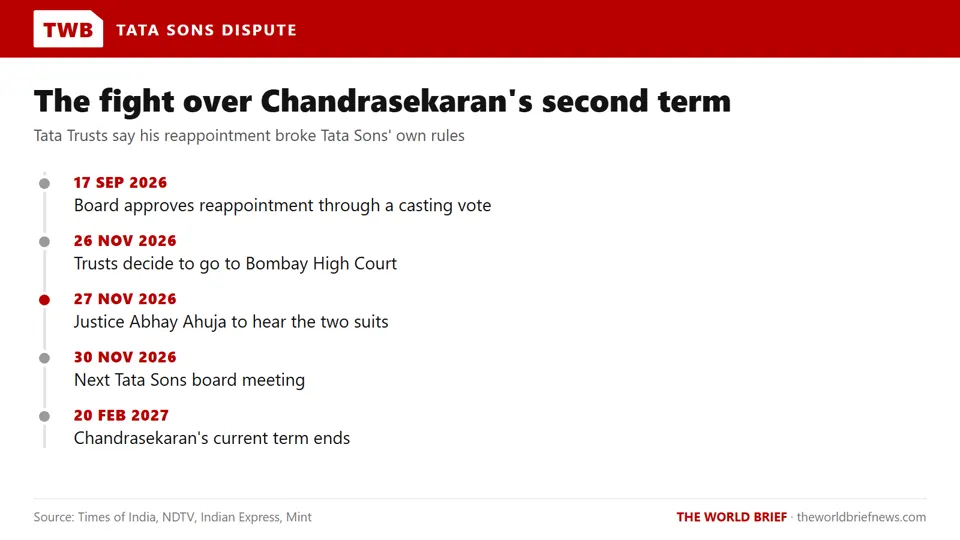
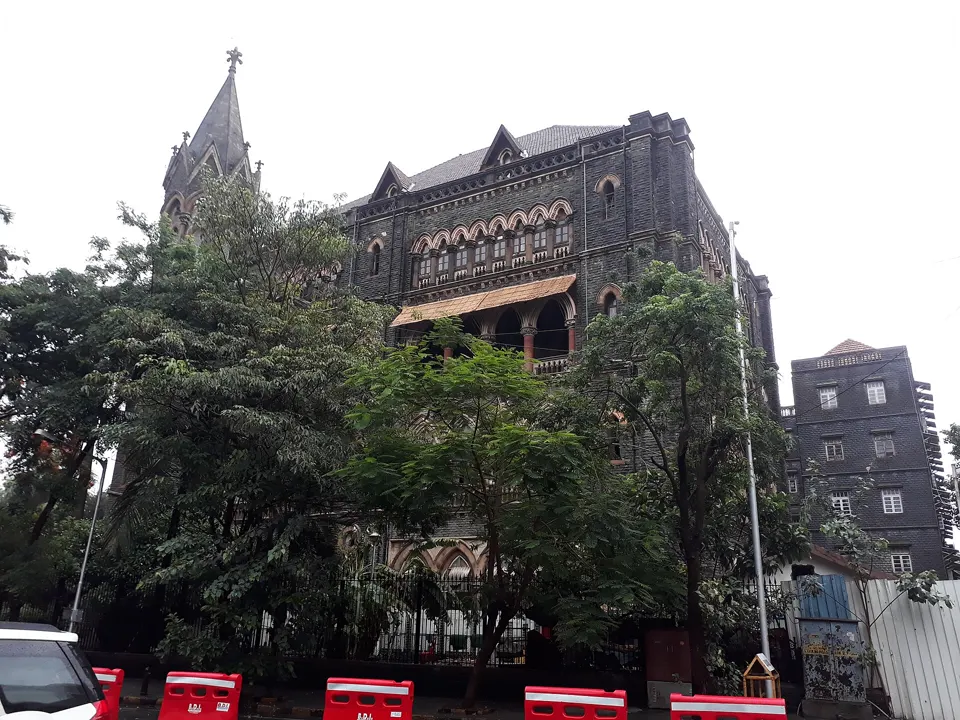
Updated 27 November 2026, 9:15 pm IST: The Bombay High Court on Friday refused to grant the Tata Trusts any urgent relief. Justice Abhay Ahuja allowed Tata Sons to hold its board meeting on Monday, 30 November, as scheduled, but said any outcome of the meeting will be subject to the court's final orders, PTI and Business Today reported. The case will be heard again in January 2027.
The battle for control at the top of the Tata group has reached the courts. Two of the biggest Tata Trusts have asked the Bombay High Court to cancel N. Chandrasekaran's reappointment as chairman of Tata Sons and to stop the use of a chairman's "casting vote" at the board meeting on Monday, 30 November.
The Sir Dorabji Tata Trust and the R.D. Tata Trust have also claimed ₹65 crore in damages from Tata Sons and its board, except trusts chairman Noel Tata, plus 18% annual interest, The Times of India reported. Justice Abhay Ahuja agreed to hear the two suits on Friday after another judge, Justice Arif Doctor, recused himself.
Quick facts
- Who is suing: Sir Dorabji Tata Trust and the R.D. Tata Trust, the two largest Tata Trusts.
- What they want: the 17 September resolution reappointing Chandrasekaran declared invalid, and no casting vote when Trust nominees disagree.
- Damages claimed: ₹65 crore plus 18% interest a year (Times of India).
- Hearing: Friday, 27 November, before Justice Abhay Ahuja.
- Deadline pressure: Tata Sons board meets on 30 November; Chandrasekaran's current term ends on 20 February 2027.
What happened at the September board meeting
On 17 September the Tata Sons board approved a second five-year term for Chandrasekaran from February 2027. The Trusts have two nominee directors on the board, and they split: Noel Tata voted against and Venu Srinivasan voted in favour, according to NDTV and The Times of India.
Chandrasekaran stepped away from that item, so independent director Harish Manwani chaired it and used his casting vote to carry the resolution.

The rule at the centre of the case
The Trusts rely on Article 121 of Tata Sons' articles of association. They read it to mean that key board decisions need a majority of the Trusts' nominee directors to vote in favour. With only two nominees, that means both must agree, and a casting vote cannot fix a 1-1 split, The Times of India reported. They also argue the reappointment should have gone through a selection committee under Article 118.
The Trusts fear the same tie-breaker will be used on 30 November on bigger items, including turning Tata Sons into a public company and listing it, changing its articles, and calling a shareholders' meeting on the reappointment.
The Trusts are split too
The decision to go to court was itself taken by vote. Noel Tata, Neville Tata and Bhaskar Bhat backed it, while Venu Srinivasan and Vijay Singh opposed it, NDTV reported.
TWB analysis: why this matters beyond one job
The Tata Trusts own the majority of Tata Sons, the unlisted holding company that sits above listed firms such as TCS, Tata Motors, Tata Steel and Titan. If the court agrees that a casting vote cannot override a split among Trust nominees, the Trusts' two directors effectively get a veto on top decisions. If it does not, the board can move ahead on issues like a possible listing even when the Trusts' own nominees disagree. Either way, the ruling will shape who really runs India's largest business group.
What it means for you
- Shareholders of listed Tata companies: nothing changes in day-to-day business, but a long legal fight could weigh on sentiment.
- A Tata Sons IPO: any move to list Tata Sons, which retail investors have watched for years, now depends partly on this case.
- Watch Monday: what the board does on 30 November, and whether the court grants any interim order before that.
What the court said on 27 November
- No stay: the court declined to defer the 30 November meeting or to bar the chairman from using a casting vote. "Let the meeting go on as per schedule," the bench said, according to PTI.
- Decisions stay open: any resolution passed on 30 November will be subject to the court's final orders, so it could still be undone if the Trusts win.
- Next steps: Tata Sons and its directors must file replies. The next hearing is in January 2027 (PTI reported 18 January; Business Today reported 21 January).
- The arguments: Senior Advocate Harish Salve, for Tata Sons, said the meeting had to go ahead because of a Reserve Bank of India deadline in mid-December on the listing requirement. Senior Advocate Abhishek Manu Singhvi, for the Sir Dorabji Tata Trust, called that "fake urgency", PTI reported.
The 30 November agenda includes the RBI's listing mandate for Tata Sons and the date for an extraordinary general meeting, Business Today reported. Separately, trustees Vijay Singh and Venu Srinivasan have asked the Maharashtra Charity Commissioner to look into the Trusts' decision to sue.
TWB analysis: a win for Tata Sons, for now
The order lets Chandrasekaran and the board act on 30 November, including on the RBI listing question. But because every decision is "subject to final orders", the dispute is far from settled: if the court later finds the 17 September reappointment invalid, decisions taken in the meantime could be challenged. Expect the real fight to resume in January.
What we don't know yet
The outcome of Friday's hearing, and whether the court will pass an interim order before the 30 November meeting, is not yet known. Tata Sons' formal response to the suits has not been reported. We will update this story after the hearing.
More on The World Brief
- More business news
- Tata Steel's APL Apollo stake explained
- Flipkart CEO Kalyan Krishnamurthy steps down
Correction, 27 November 2026: an earlier version of this story named the second trust as the Ratan Tata Trust. It is the R.D. Tata Trust, according to PTI and Business Today.
Sources
- PTI (via MSN): HC refuses urgent relief to Tata Trusts, says Tata Sons board meet can go on, 27 Nov 2026
- Business Today (via MSN): Bombay HC declines to block November 30 board meet or casting vote, 27 Nov 2026
- LiveLaw: Bombay High Court refuses interim relief in Tata Trusts suits
- The Times of India (via MSN): Trusts move HC to block chair's casting vote at Tata Sons meet
- NDTV (via MSN): Tata Trusts to go to court against N Chandrasekaran's reappointment
- Mint: Tata Trusts sue to strip chairman of casting vote
- Financial Express: Bombay HC to hear Tata Trusts case against Chandrasekaran's reappointment on Nov 27