New motor insurance rules from 15 December: your car and bike policy splits into 4 parts
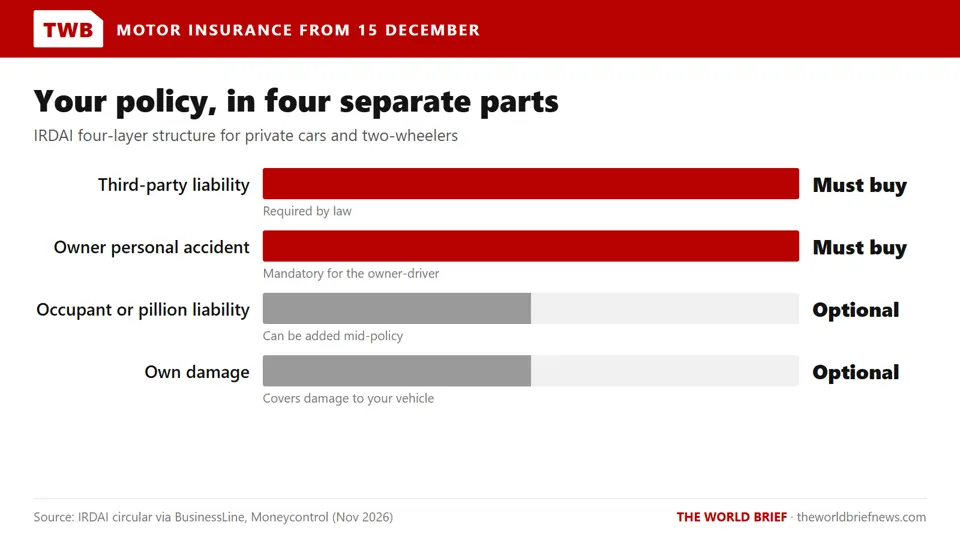
From 15 December 2026, IRDAI requires insurers to sell car and two-wheeler policies in four clearly priced sections, with only third-party and owner accident cover compulsory, under a Supreme Court direction.
Key points
- From 15 December 2026, private car and two-wheeler policies must be split into four sections
- Third-party liability and personal accident cover for the owner-driver stay compulsory
- Cover for occupants or pillion riders, and own-damage cover, become clearly optional
- Every buyer must fill an option form, and insurers must give a Customer Information Sheet showing the premium for each part
- Existing policyholders can add occupant or pillion cover mid-term by paying extra
Last checked: 26 November 2026. From 15 December 2026, car and two-wheeler insurance in India changes shape. The Insurance Regulatory and Development Authority of India (IRDAI) has told all general insurers to sell policies for private cars and two-wheelers in four separate sections, each with its own price, BusinessLine reported.
The aim is simple: you should be able to see exactly what you are buying, what is compulsory and what is optional. The change follows a Supreme Court direction in the case National Insurance Company Ltd vs Thungala Dhana Laxmi & Others.
What changes on 15 December
- Policies for private cars and two-wheelers are split into 4 sections.
- Only third-party liability and owner-driver personal accident cover are compulsory.
- You must fill an option form ticking the covers you want, online or offline.
- Insurers must give a Customer Information Sheet (CIS) showing the premium for each section.
- Policies must also be available on Bima Sugam, the insurance marketplace, from the same date.
The four parts of your new motor policy
- Third-party liability (compulsory): covers damage or injury you cause to other people or their property. It is required by law, and you cannot opt out.
- Legal liability to occupants or pillion riders (optional): covers your legal liability to passengers in your car or a pillion rider on your bike, including employees.
- Personal accident cover: cover for the owner-driver is compulsory; cover for other occupants, pillion riders and paid drivers is optional, Moneycontrol reported.
- Own damage (optional): pays for loss of or damage to your own vehicle, from accidents, theft, fire or floods. Insurers set this price based on market forces.
What it means for you
- Buying or renewing after 15 December: expect an option form. Read it carefully: unticking a box removes that cover.
- Check the CIS: it shows what each part costs, so you can compare insurers properly.
- Already have a policy? Nothing changes until renewal. But you can add occupant or pillion liability cover mid-term by paying an extra premium.
- Loan on the vehicle? Lenders usually require own-damage cover, so don't drop it if your car or bike is financed.
"The new framework provides customers with wider coverage along with clarity and choice," said Shanai Ghosh, MD and CEO of Zuno General Insurance, Moneycontrol reported.
TWB analysis: cheaper is not always better
Splitting the policy makes it tempting to buy only the two compulsory parts to save money. But third-party cover pays nothing for damage to your own vehicle. For a new or financed vehicle, dropping own-damage cover could leave you paying the full cost of repairs after an accident. The new rules give you choice; use it to remove covers you truly don't need, not ones that protect your biggest risk.
What we don't know yet
It is not yet clear how much premiums will change for typical policies once each section is priced separately. We will update this guide when insurers publish new rates.
This is general information, not insurance advice.
With inputs from BusinessLine and Moneycontrol.
More on The World Brief
- December 2026 money deadlines and rule changes
- IRDAI fines Star Health ₹2 crore over claim rejections
- SBI credit card: new charges from 1 December
Sources
- Insurance Regulatory and Development Authority of India (official)
- BusinessLine: IRDAI mandates four-layer motor insurance structure from December 15, 3 Nov 2026
- Moneycontrol: IRDAI's four-layer motor insurance framework, what vehicle owners need to know
- Business Standard: IRDAI introduces four-layer motor insurance structure from December 15