RBI's proposed 'Stop Switch': block all payments from your bank account in one tap
RBI's draft rules would let customers freeze all outgoing digital payments instantly, set their own daily limits and name a trusted person to approve big transfers; comments are open until 14 December 2026.

Key points
- The RBI has proposed a 'Stop Switch' that blocks all customer-initiated outgoing debits in one step if you suspect fraud
- Customers could set their own limits per transaction, per beneficiary and per day for each payment channel
- An optional 'trusted person' aged 18 or above could be asked to approve transfers above a limit you choose
- These are draft rules for commercial banks; public comments are open until 14 December 2026
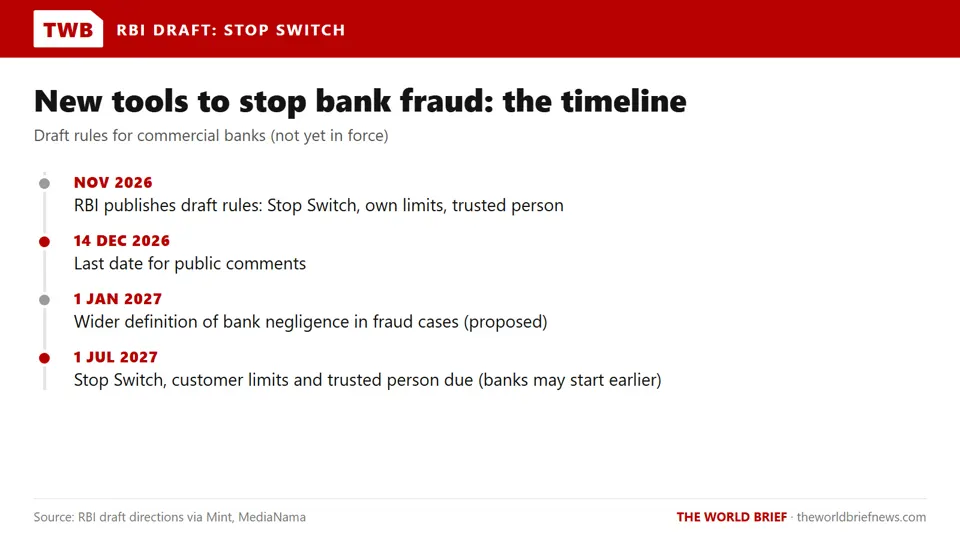
- If finalised, the tools would start by 1 July 2027, and a wider definition of bank negligence from 1 January 2027
Last checked: 26 November 2026. The Reserve Bank of India (RBI) has proposed a set of new tools to help bank customers stop online fraud before money leaves their account. The best-known is a "Stop Switch": one action that blocks all outgoing digital payments from your account if you think it has been compromised.
These are draft rules, not yet in force. The RBI is taking public comments until 14 December 2026. If finalised, most of the new tools would start by 1 July 2027, Mint reported.
The three big proposals
- Stop Switch: freeze all outgoing payments you could make, in one step.
- Your own limits: set maximum amounts per transaction, per beneficiary, per channel and per day.
- Trusted person: name someone aged 18 or above to approve large transfers.
1. The Stop Switch
If you suspect fraud, the Stop Switch would immediately stop:
- new debit transactions you initiate (UPI, net banking, cards and so on);
- new payment mandates and standing instructions;
- registering your UPI on a new third-party payment app.
It would not freeze your whole account. Money can still come in, existing auto-payments and standing instructions continue, and bank debits such as loan EMIs still go through. You could turn it off after authentication, though banks may add a cooling-off period.
2. Set your own transaction limits
Instead of relying only on your bank's limits, you could set your own. For example, you could cap payments to one beneficiary at ₹20,000 a day, or limit one payment channel to ₹10,000 per transaction, according to Mint. You could also switch card payments (domestic, international, ATM, online, contactless) on or off, and block some channels during certain hours.
Banks would also have to keep digital payment channels switched off by default for new customers until they give clear consent.
3. A trusted person for big transfers
- You could nominate a trusted person aged 18 or above, such as a son, daughter or spouse.
- You choose the amount above which their approval is needed.
- They get the transfer details and have one hour to approve. If they reject it or don't respond, the transfer is declined.
- They cannot see your balance, deposits or investments, cannot start transactions, and are not liable for what they approve.
- It would not apply to UPI transfers, shop payments or recurring payments.
MediaNama noted that this may especially help elderly customers who are targets of social engineering scams.
Who would be covered?
The draft applies to commercial banks such as SBI, HDFC Bank and ICICI Bank. It does not cover small finance banks, payments banks, regional rural banks or local area banks, MediaNama reported. The RBI also plans to widen the definition of "negligence by a bank" in fraud cases from 1 January 2027.
TWB analysis: what would have changed in a typical scam
In most digital arrest and fake-KYC scams, victims are pressured into making several large transfers within minutes. A trusted-person rule with a one-hour window would add a second pair of eyes to each big transfer, and a Stop Switch would let a worried family member help shut the door in one step. Neither tool stops a scam call, but together they could slow the money down, which is often what decides whether it can be recovered.
What you can do now
- The tools are not live yet. Today, call your bank's 24x7 helpline or the national cyber fraud helpline 1930, or report at cybercrime.gov.in, as soon as you spot fraud.
- You can send comments on the draft to the RBI by 14 December 2026 (details on rbi.org.in).
With inputs from Mint and MediaNama.
More on The World Brief
- How to block a lost or stolen phone
- CERT-In warns of AI-driven cyberattacks on payment systems
- December 2026 money deadlines