SEBI eases KYC rules from 24 December: mobile check optional, faster closures, DIGIPIN added
SEBI's new KYC rules, effective 24 December 2026, let brokers skip mobile re-verification for Aadhaar-seeded numbers and force faster delinking of closed accounts from KYC registration agencies.
Key points
- SEBI issued the circular on 25 November 2026; the changes take effect on 24 December 2026
- Brokers and fund houses can skip mobile verification if the number in the KYC registration agency (KRA) record is already verified and Aadhaar-seeded
- A KYC record can be treated as validated if either the current or the permanent address is verified
- Closed accounts must be reported to the KRA within five working days, and the KRA must delink them within two
- India Post's DIGIPIN digital address code is being added to KYC records
Last checked: 27 November 2026. Opening a new demat, trading or mutual fund account will get a little easier from 24 December 2026. The Securities and Exchange Board of India (SEBI) has changed its Know Your Customer (KYC) rules to cut repeat checks for investors and to stop old brokers from receiving your KYC updates after you close an account.
SEBI announced the changes on 25 November, The Hindu and Business Standard reported. They apply to stock brokers, depositories, mutual funds and their registrars, and the KYC registration agencies (KRAs) that store investors' KYC records.
What changes on 24 December
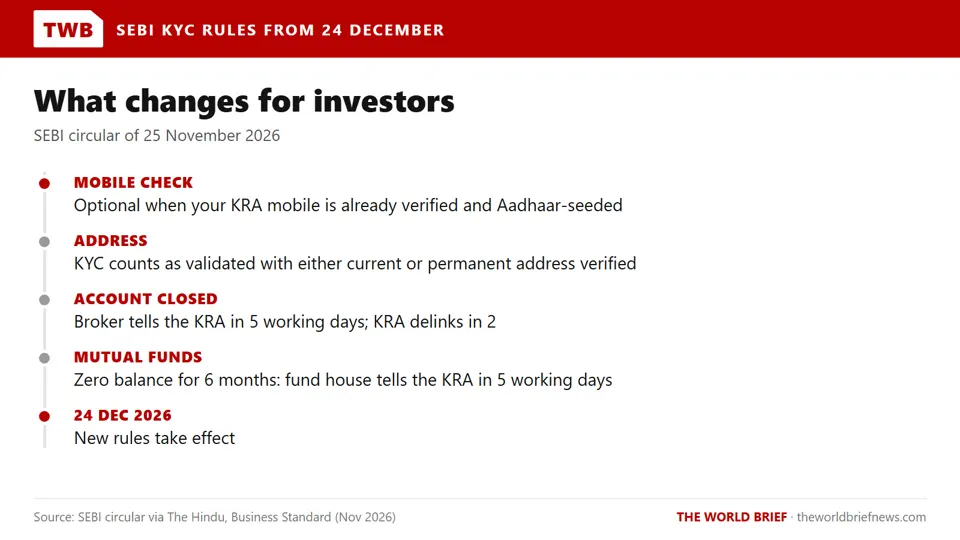
- No repeat mobile check: optional if your mobile number in the KRA record is already verified and Aadhaar-seeded.
- Easier address validation: verifying either your current or your permanent address can be enough.
- Faster delinking: closed accounts must be reported to the KRA within 5 working days, and delinked within 2.
- DIGIPIN: India Post's digital address code joins KYC records.
1. No repeat mobile verification
Today, every new broker or fund house may ask you to verify your mobile number again. Under the new rules, verification will be optional for the intermediary if the number in the KRA system has already been verified and tagged as Aadhaar-seeded, according to The Hindu.
2. Easier address and name updates
- A KYC record can be treated as validated when it is verified against official databases and either the current or the permanent address checks out.
- KRAs will flag individual details that are not validated, so intermediaries ask only for what is missing rather than putting your whole KYC on hold.
- Name changes become simpler when the new name already appears on both PAN and Aadhaar.
- Resident Overseas Citizens of India (OCI) and foreign nationals living in India get relief on overseas address documents.
3. Your data stops flowing to old brokers
- Account closed: the broker must tell the KRA within 5 working days, and the KRA must delink the record within 2 working days.
- Dormant mutual fund folio: if a folio has had a zero balance with no transactions for six consecutive months, the fund house or registrar must tell the KRA within 5 working days, and the KRA stops sharing your KYC updates with it.
- Account never opened: if an intermediary downloads your KYC record but you don't open an account within 21 working days, the record must be delinked.
TWB analysis: what it means for you
The biggest everyday gain is fewer OTPs and less paperwork when you switch brokers or start investing with a new fund house. The privacy change matters too: today, a broker you left years ago can keep receiving updates whenever you change your address or phone number. From 24 December, that link should be cut within about a week of closing the account (5 + 2 working days, our calculation).
What you should do now
- Check your KYC status on a KRA website (such as CAMS, KFintech, CVL, NDML or NSE's DotEx). It should show KYC Validated or KYC Registered.
- Make sure your mobile number is linked to Aadhaar. That is what lets future intermediaries skip the extra check.
- Close broker or demat accounts you no longer use, so the new delinking rules can protect your data.
This is general information, not investment advice.
With inputs from The Hindu and Business Standard.
More on The World Brief
- Is your PAN active? How to check
- SEBI's advisory on IPO grey market premiums
- RBI's proposed Stop Switch for bank accounts