ESA's Hera Spacecraft Reveals Stadium-Sized Crater and Chaotic Tumbling on Asteroid Dimorphos After NASA's DART Impact
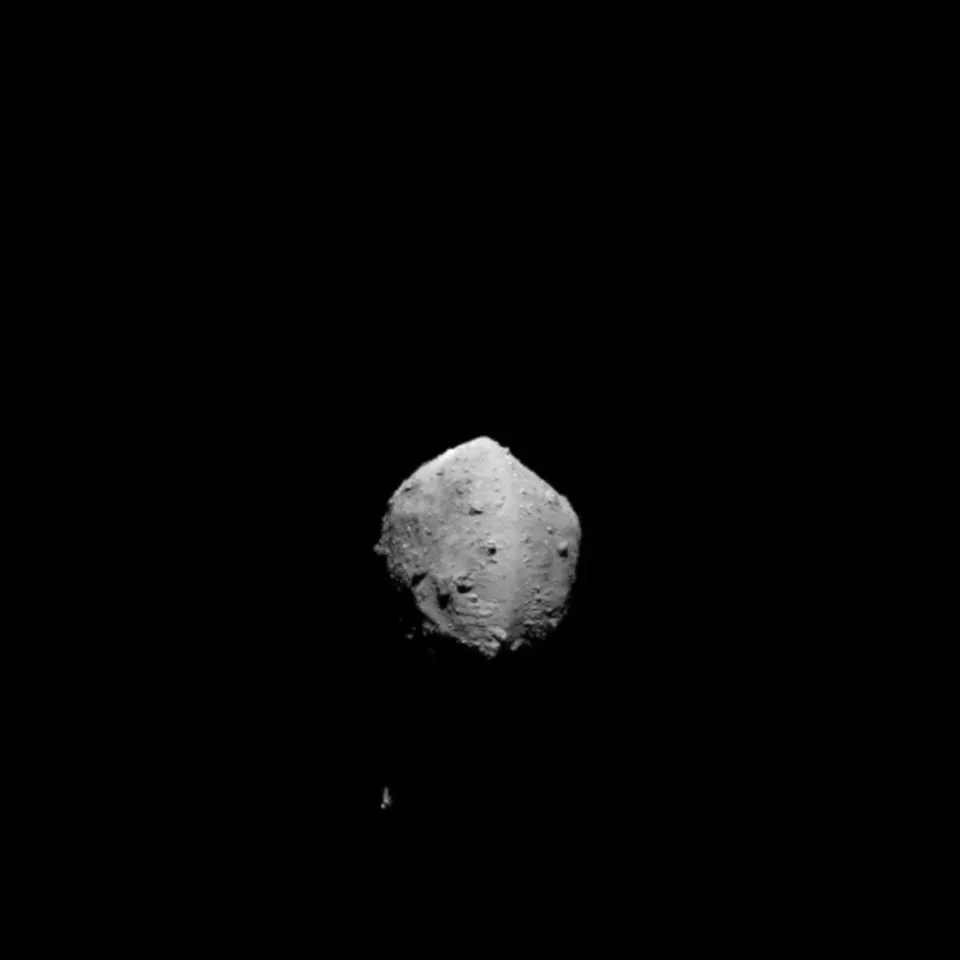
First close-up images from ESA's Hera mission released Nov 25 show NASA's DART impact flattened one face of Dimorphos, leaving it tumbling amid boulders.
Key points
- First close-up Hera images released Nov 25 show NASA's 2022 DART strike flattened one entire face of ~151m Dimorphos into a stadium-sized crater.
- The impact knocked Dimorphos out of tidal lock into chaotic tumbling and blasted hundreds of boulders into orbit around the pair.
- CubeSats Juventas and Milani remain aboard Hera for closer Dec 2026 flybys and scheduled Jan 2027 radar deployment.
Four years after NASA deliberately slammed a spacecraft into an asteroid to test whether humanity can deflect a cosmic threat, the European Space Agency's (ESA) Hera probe has delivered its first close-up "crash-scene" images—revealing that the 2022 collision dramatically reshaped the target moonlet Dimorphos and left it tumbling chaotically through space. Unveiled at a joint ESA and German Aerospace Center (DLR) briefing at Berlin's Museum für Naturkunde on Wednesday, November 25, 2026, the images show NASA's Double Asteroid Redirection Test (DART) carved an impact crater roughly the size of a sports stadium across almost the entire width of the 151-meter asteroid.
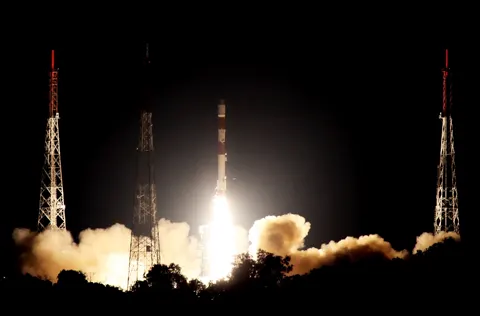
Launched in October 2024 on a two-year voyage to the Didymos–Dimorphos binary system, Hera began capturing high-resolution Asteroid Framing Camera views from roughly 25 to 30 kilometers away upon arriving in November 2026. The close-up frames immediately resolved a four-year scientific debate—proving that a kinetic strike on a loosely bound "rubble-pile" asteroid does not leave a neat textbook dent, but can globally deform the target body.
Three Major Discoveries From Hera's Arrival Imagery
- One Face Completely Flattened Into a Stadium-Sized Crater: Before Hera arrived, models split over whether DART carved a localized pit, reshaped the entire moonlet, or barely dented it. "Much to our surprise, the answer turns out to be all three at once!" said Hera Principal Investigator Patrick Michel. "The face struck by DART has been flattened into an impact crater…" Images even reveal a distinct "cigar-shaped" structure near the crater center, while wiping away most original surface boulders on that side.
- Knocked Into Chaotic 'Barrel-Tumbling' Motion: Prior to the September 2022 collision—which shaved 33 minutes off Dimorphos's ~12-hour orbit—the moonlet was tidally locked, always keeping one side facing larger parent asteroid Didymos (~730 meters wide). Now, Hera confirms Dimorphos is tumbling erratically. Planetary scientist Sabina Raducan compared the chaotic spin to "a barrel that you throw down the stairs... basically that's what Dimorphos…"
- A Swarm of Hundreds of Orbiting Boulders: ESA Mission Scientist Michael Küppers highlighted another major surprise: "Hera is showing that the asteroids are surrounded by hundreds of orbiting…" blasted free by the kinetic impact. Meanwhile, primary asteroid Didymos itself appears structurally intact with its equatorial ridge undisturbed.
What Happens Next: Dec 2026 Approach & Jan 2027 CubeSat Deployment
- Still Aboard for Now: Both of Hera's briefcase-sized companion CubeSats—Milani and Juventas—remain stowed aboard the main spacecraft as of late November 2026.
- December 2026–January 2027 Operations: Hera will steer closer to roughly 13 kilometers in December 2026 before deploying both CubeSats in January 2027. Milani will conduct surface mineral spectroscopy and dust measurements, while Juventas carries the JuRa low-frequency radar instrument to perform humanity's first-ever radar sounding of an asteroid's interior structure before both attempt low-gravity touchdowns.
Turning a Single Test Into Reliable Planetary Defense
Mission leaders stressed that understanding how loose rubble-pile asteroids absorb momentum—including the extra kick provided by flying debris—is essential before Earth ever faces a real incoming threat.
"NASA's DART mission demonstrated that we can change an asteroid's orbit. Hera…" said ESA Hera Project Manager Ian Carnelli. "By combining these two missions, humanity is taking a decisive step towards…" DLR Divisional Board Member Anke Pagels-Kerp called the images "proof that we are no longer helpless in the face of dangers from space."
Why This Matters
Space agencies worldwide—including ISRO's planetary science community tracking near-Earth objects—rely on calibrated impact physics rather than guesswork. Hera's data reveals that hitting a rubble-pile asteroid hard enough can fracture its spin stability and create an orbiting debris cloud, crucial lessons so future deflection missions do not accidentally split a hazardous space rock into multiple Earth-bound fragments.
What Happens Next
Hera moves down toward a ~13 km close approach in December 2026 to weigh Dimorphos's exact mass via subtle gravitational pull, followed in January 2027 by the release of Juventas and Milani to probe inside the shattered moonlet for the first time.
With inputs from the official sources and outlets listed below.